How to Become an AI/ML Engineer in Singapore (2026 Guide)
A complete guide to becoming an AI/ML engineer in Singapore. Earn S$65k–S$220k/yr. Skills, salary data, and career roadmap — free to explore.
AI and machine learning engineering is one of the fastest-growing tech careers in Singapore. With the government's National AI Strategy 2.0 accelerating adoption across finance, healthcare, logistics, and the public sector, companies are competing hard for AI/ML talent at every level. If you want to know how to become an AI ML engineer in Singapore, this guide covers the skills, salaries, pathways, and hiring landscape you need to navigate.
Whether you're a computer science graduate, a data analyst looking to level up, or a career switcher with a quantitative background, there's a viable route into AI/ML engineering here. The pay is strong, the demand is real, and the skills you build transfer globally.
What Does an AI/ML Engineer Do in Singapore?
AI/ML engineers design, build, and deploy machine learning models that power intelligent products and services. In Singapore, you'll find AI/ML engineers building fraud detection systems at banks like DBS, optimising delivery routes at Grab, developing recommendation engines at Shopee, or advancing national research at A*STAR and AI Singapore.
Your day-to-day work involves collecting and preprocessing data, training and evaluating models, deploying them into production systems, and monitoring their performance over time. Unlike data scientists who focus heavily on analysis and experimentation, AI/ML engineers own the full lifecycle — from prototype to production-grade system running at scale.
Depending on your seniority, you might also design ML infrastructure, set up experiment tracking pipelines, mentor junior engineers, or make architectural decisions about which models and frameworks to adopt. Singapore's position as a regional AI hub means you'll frequently work with cross-functional teams across Southeast Asia, making communication skills just as important as your technical depth.
AI/ML Engineer Salary in Singapore
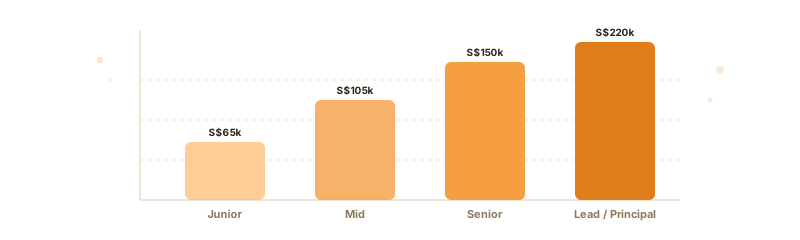
AI/ML engineering is one of Singapore's fastest-growing and highest-paying tech roles. Here's what you can expect at each level, based on data from Robert Walters Singapore:
Junior AI/ML Engineer (0–2 years): S$65,000/year
Fresh graduates from NUS or NTU computer science programmes with ML specialisations typically start around S$65,000–S$80,000. Candidates with strong internship experience at research labs or AI-focused companies may command higher starting offers.
Mid-Level AI/ML Engineer (2–5 years): S$105,000/year
At this stage, you're expected to independently design and deploy ML systems, run experiments, and contribute to production pipelines. Companies pay a premium for engineers who can bridge the gap between research and production.
Senior AI/ML Engineer (5–8 years): S$150,000/year
Senior AI/ML engineers lead model development, make architecture decisions, and set technical standards for ML teams. At top-tier companies like Google, Grab, and Sea AI Lab, total compensation with bonuses and equity can push well beyond this.
Lead AI/ML Engineer (8+ years): S$180,000/year
Lead engineers shape the AI strategy for entire product areas or organisations. You're mentoring teams, driving research directions, and ensuring ML systems are reliable, fair, and scalable.
The full salary range for AI/ML engineers in Singapore spans S$65,000 to S$220,000 per year, depending on experience, company, and specialisation. This makes it one of the highest-paying technical career paths in the country.
Skills You Need to Become an AI/ML Engineer
To become an AI/ML engineer in Singapore, you need to build competency across 19 core skills spanning technical foundations, professional abilities, domain knowledge, and emerging technologies.
Technical foundations:
- Python Programming — the primary language for ML development; you need to be fluent in NumPy, pandas, scikit-learn, and PyTorch or TensorFlow
- Data Wrangling & Preprocessing — cleaning, transforming, and preparing raw data for model training
- Machine Learning Fundamentals — supervised and unsupervised learning, model evaluation, feature engineering, and hyperparameter tuning
- Deep Learning Introduction — neural networks, CNNs, RNNs, and transformer architectures
- MLOps Basics — experiment tracking, model versioning, CI/CD for ML, and tools like MLflow and Weights & Biases
- Cloud Computing for ML — deploying and scaling models on AWS SageMaker, Google Vertex AI, or Azure ML
- Advanced ML Algorithms — ensemble methods, reinforcement learning, and optimisation techniques for complex problems
- Distributed Systems & Big Data — Spark, distributed training, and handling datasets that don't fit on a single machine
- Effective Communication — presenting model results to non-technical stakeholders and writing clear documentation
- Teamwork & Collaboration — working with data engineers, product managers, and domain experts to ship ML products
- Analytical & Problem Solving — structuring ambiguous problems and choosing the right modelling approach
- Continuous Learning — ML moves fast; you need to stay current with papers, frameworks, and best practices
- Fintech AI Applications — credit scoring, fraud detection, algorithmic trading, and anti-money laundering models
- E-commerce AI Applications — recommendation systems, search ranking, dynamic pricing, and demand forecasting
- Mobility & Logistics AI — route optimisation, ETA prediction, and autonomous vehicle systems
- AI Ethics & Governance — Singapore's Model AI Governance Framework, bias detection, and responsible AI practices
- Explainable AI (XAI) — making model predictions interpretable for regulatory and business requirements
- Generative AI — large language models, diffusion models, and building applications with foundation models
- Federated Learning — privacy-preserving ML techniques increasingly relevant for healthcare and finance use cases
How to Become an AI/ML Engineer in Singapore (Step-by-Step)
There are structured paths into AI/ML engineering in Singapore, and the ecosystem of government support makes this a particularly strong place to build this career.
University path
A degree in Computer Science, Electrical Engineering, or Mathematics from a strong programme is the most common entry point. NUS School of Computing and NTU College of Computing and Data Science are the top choices, both offering AI/ML specialisations and strong research output. These programmes give you the mathematical foundations — linear algebra, probability, statistics, and optimisation — that underpin all machine learning work.
If you're already in university studying a related field, look for ML electives, capstone projects involving data, and undergraduate research opportunities with faculty working on AI.
Government programmes and support
Singapore's National AI Strategy 2.0 has created significant infrastructure to grow local AI talent. Take advantage of these programmes:
- AI Singapore (AISG) runs several talent development initiatives, including the AISG100 apprenticeship — a 9-month programme that pairs you with industry partners to work on real AI projects. This is one of the best ways to get hands-on ML experience if you're early in your career.
- IMDA TeSA (TechSkills Accelerator) offers training programmes, certifications, and placement support for tech roles including AI/ML. Check IMDA's website for current programme listings.
- SkillsFuture credits can offset the cost of AI and data science courses from approved providers, including courses on Coursera, DataCamp, and local training partners.
- Build your math and programming foundation — Get solid with Python, linear algebra, calculus, probability, and statistics. These aren't optional for ML; they're the core
- Learn machine learning fundamentals — Work through courses like Andrew Ng's Machine Learning Specialisation or fast.ai. Implement algorithms from scratch to build intuition
- Complete hands-on projects — Build 3–5 ML projects with real datasets. Deploy at least one model as an API or web application. Kaggle competitions are useful but deployed projects carry more weight
- Learn MLOps and production skills — Understand how to version models, set up training pipelines, monitor model drift, and deploy reliably. This separates engineers from researchers
- Gain experience through apprenticeships or internships — Apply for the AISG100 apprenticeship, IMDA-supported placements, or internships at companies with ML teams
- Specialise in a domain — Singapore's strongest AI demand is in fintech, e-commerce, logistics, and government services. Pick a domain and go deep
- Prepare for ML interviews — Expect coding challenges, ML system design questions, and deep dives into your project work. Be ready to explain model choices, trade-offs, and deployment decisions
Top Companies Hiring AI/ML Engineers in Singapore
Singapore's AI ecosystem spans government research labs, homegrown tech companies, and global firms with significant regional AI teams.
Research and government:
- A*STAR — Singapore's lead public research agency, with dedicated AI and ML research groups
- DSO National Laboratories — National defence R&D, working on advanced AI applications
- GovTech — Building AI-powered government services as part of Smart Nation
- AI Singapore (AISG) — National AI programme that also hires researchers and engineers directly
- DBS AI team — One of the most advanced AI teams in Asian banking, working on fraud detection, customer intelligence, and process automation
- Sea AI Lab — The research arm of Sea Group, publishing at top ML conferences
- Grab — Heavy AI/ML use across ride-hailing, food delivery, fintech, and mapping
- Bytedance SG — Recommendation systems, NLP, and computer vision at massive scale
- Salesforce Research SG — Applied AI research with a focus on enterprise applications
- Google — DeepMind and Google Research presence, plus ML engineering roles across products
- Microsoft — Azure AI and research teams
- Alibaba DAMO Academy — Fundamental AI research with Southeast Asian applications
Frequently Asked Questions
Is AI/ML Engineering a good career in Singapore?
Yes. AI/ML engineering offers some of the highest salaries in Singapore's tech sector (S$65k–S$220k range), strong demand driven by the National AI Strategy 2.0, and clear career progression. Singapore's position as Southeast Asia's AI hub means you'll have access to cutting-edge work across finance, government, and consumer tech. The skills also transfer globally — AI/ML engineers trained in Singapore are competitive for roles anywhere.
What qualifications do I need to become an AI/ML Engineer in Singapore?
A bachelor's degree in Computer Science, Mathematics, Statistics, or Electrical Engineering is the most common qualification. A master's or PhD helps for research-heavy roles but isn't required for most engineering positions. What matters more is demonstrable skill: strong Python programming, solid understanding of ML algorithms, hands-on project experience, and the ability to deploy models into production. Programmes like AISG100 and IMDA TeSA can help you build credentials without a postgraduate degree.
What is the salary for an AI/ML Engineer in Singapore?
Based on Robert Walters Singapore data, AI/ML engineers earn between S$65,000 and S$220,000 per year. Junior engineers (0–2 years) start around S$65,000, mid-level (2–5 years) earn approximately S$105,000, senior engineers (5–8 years) reach S$150,000, and leads (8+ years) earn S$180,000 and above. Total compensation at top companies can be significantly higher when you include bonuses and equity.
How is AI/ML Engineering different from Data Science?
Data scientists focus on analysis, experimentation, and extracting insights from data. AI/ML engineers focus on building production systems — taking models from notebooks to scalable, reliable services. As an AI/ML engineer, you spend more time on software engineering, MLOps, infrastructure, and deployment. You need stronger coding skills and systems thinking. In practice, many Singapore companies expect overlap between the two roles, but the engineering side commands higher salaries and focuses more on building than analysing.
What Singapore government programmes help with an AI career?
Several programmes support AI career development. AI Singapore (AISG) runs the AISG100 apprenticeship, a 9-month hands-on programme pairing you with industry AI projects. IMDA TeSA offers training subsidies, certifications, and job placement support for tech roles including AI/ML. SkillsFuture credits can be used for approved AI and data science courses. The government's National AI Strategy 2.0 is also driving demand across public and private sectors, creating more entry points for new AI/ML engineers.
Ready to apply for ai ml engineer roles?
Run your resume through our free checker to see how it performs for Singapore employers.
Check my resume →Ready to start your journey?
Explore the interactive skill tree with all the skills mapped out — from beginner to expert.
Explore the full skill path →