How to Become a Data Scientist in Singapore (2026 Guide)
A complete guide to becoming a data scientist in Singapore. Earn S$60k–S$200k/yr. Skills, salary data, and career roadmap — free to explore.
Data science is one of Singapore's fastest-growing career paths. As companies across banking, logistics, healthcare, and government race to make better decisions with data, demand for data scientists has surged at every level. If you're figuring out how to become a data scientist in Singapore, this guide walks you through the skills, salaries, education paths, and hiring landscape you need to know.
Whether you're a fresh graduate from NUS or NTU, a polytechnic diploma holder, or a mid-career professional in finance looking to switch, there's a viable route into data science here. The pay is strong, career progression is clear, and Singapore's position as a regional data and AI hub means your skills are highly transferable across Southeast Asia and beyond.
What Does a Data Scientist Do in Singapore?
Data scientists extract insights from large datasets to help organisations make better decisions. In Singapore specifically, you'll find data scientists working across fintech (DBS, OCBC, UOB), government agencies (GovTech, A*STAR), ride-hailing and logistics (Grab), e-commerce (Shopee, Lazada), and consulting firms advising clients across the region.
Your day-to-day work typically involves cleaning and exploring datasets, building predictive models, running experiments and A/B tests, creating dashboards and visualisations, and presenting findings to stakeholders who may not have a technical background. Depending on your seniority, you might also deploy machine learning models into production, design data pipelines, or lead a team of analysts and junior scientists.
What sets data science apart from pure software engineering is the blend of statistics, domain expertise, and programming. You need to understand the business problem deeply before you write a single line of code. In Singapore's financial sector especially, data scientists are expected to bridge the gap between quantitative analysis and business strategy.
Data Scientist Salary in Singapore
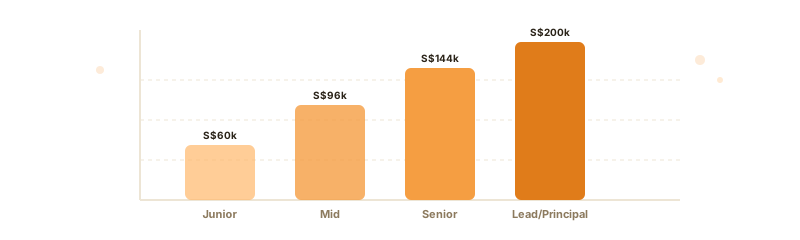
Data science is one of the higher-paying tech careers in Singapore. Here's what you can expect at each level, based on data from MyCareersFuture Singapore:
Junior Data Scientist (0–2 years): S$60,000/year
Starting salaries for fresh graduates from NUS, NTU, or SMU quantitative programmes typically fall in the S$60,000–S$75,000 range. Graduates with strong internship experience at banks or tech companies may start at the higher end.
Mid-Level Data Scientist (2–5 years): S$105,000/year
Once you've built production models and delivered measurable business impact, salaries rise sharply. At this stage, you're expected to independently scope projects, choose appropriate modelling approaches, and communicate results to non-technical stakeholders.
Senior Data Scientist (5–8 years): S$140,000/year
Senior data scientists lead complex projects, mentor junior team members, and often set the technical direction for their team's modelling and analytics work. Compensation at top firms like Grab, Google, and DBS can exceed this with bonuses and equity.
Lead / Principal Data Scientist (8+ years): S$180,000/year
At the lead level, you're defining the data science strategy for entire business units. Roles at companies like Sea Group, McKinsey, and BCG regularly offer total compensation above S$200,000.
The full salary range for data scientists in Singapore spans S$60,000 to S$200,000 per year, depending on experience, company, and specialisation.
Skills You Need to Become a Data Scientist in Singapore
Based on Singapore's job market and the data scientist career path, you need to build proficiency across 20 core skills spanning four areas:
Technical fundamentals:
- Python Programming — the primary language for data science work in Singapore
- SQL & Database Management — querying and managing the data you'll analyse daily
- Data Visualization — building clear charts and dashboards with tools like Tableau, Power BI, or matplotlib
- Statistical Analysis — hypothesis testing, regression, probability distributions
- Machine Learning Fundamentals — supervised and unsupervised learning, model evaluation, feature engineering
- Cloud Computing Platforms — AWS SageMaker, Google Cloud AI Platform, or Azure ML
- Deep Learning Concepts — neural networks, CNNs, RNNs, and transformer architectures
- Big Data Technologies — Spark, Hadoop, and working with datasets that don't fit in memory
- Natural Language Processing (NLP) — text classification, sentiment analysis, and language models
- Computer Vision — image recognition and object detection for visual data problems
- Communication Skills — translating model outputs into actionable business recommendations
- Problem-Solving — framing ambiguous business questions as data problems
- Collaboration — working across engineering, product, and business teams
- Critical Thinking — questioning assumptions in data and challenging flawed analyses
- Business Acumen — understanding how your models drive revenue, reduce cost, or improve decisions
- Finance Domain Knowledge — critical for Singapore's massive banking and insurance sector
- E-commerce Domain Knowledge — relevant for Shopee, Lazada, and regional platforms
- Healthcare Domain Knowledge — growing area with Singapore's push into health tech and biomedical sciences
- AI Ethics and Governance — increasingly important as Singapore leads on responsible AI frameworks
- MLOps Practices — deploying, monitoring, and maintaining models in production
How to Become a Data Scientist in Singapore (Step-by-Step)
There are two main paths into data science in Singapore. Both are valid, and the right one depends on where you're starting from.
Path 1: University degree
A degree in Statistics, Computer Science, Applied Mathematics, or Data Science from NUS, NTU, or SMU is the most common entry point. NUS Department of Statistics and Data Science, NTU's College of Computing and Data Science, and SMU's School of Computing and Information Systems all offer strong programmes with research opportunities and industry partnerships.
If you're already at university studying a quantitative subject like Economics, Physics, or Engineering, you're well-positioned to move into data science with some additional coursework in programming and machine learning. Many NUS and NTU graduates supplement their degrees with data science minors or specialisations.
Path 2: Career switcher
If you're a polytechnic graduate or a professional switching from finance, banking, consulting, or another quantitative field, data science is a realistic target. Your domain expertise is actually an advantage — banks like DBS and OCBC actively seek data scientists who already understand financial products and risk.
For career switchers, structured programmes are the fastest route. The IMDA TeSA (Tech Skills Accelerator) programme offers company-sponsored training and placement for mid-career professionals moving into tech roles including data science. Many of these programmes are subsidised through SkillsFuture credits and additional government grants, significantly reducing your out-of-pocket costs.
General Assembly, Vertical Institute, and Heicoders Academy all run data science bootcamps in Singapore, several of which are SkillsFuture-eligible.
Regardless of your path, here's the step-by-step:
- Build your mathematical foundation — Get comfortable with linear algebra, probability, and statistics. These underpin every model you'll ever build
- Learn Python and SQL — Python is non-negotiable. SQL is how you access data in every organisation. Learn both well before moving to machine learning
- Master data wrangling and visualisation — Most of your time will be spent cleaning and exploring data, not building models. Get fast with pandas, numpy, and matplotlib
- Study machine learning fundamentals — Understand regression, classification, clustering, and model evaluation. Work through scikit-learn before jumping to deep learning
- Build a portfolio of projects — Complete 3–5 end-to-end projects using real datasets. Kaggle competitions are fine, but projects that solve a specific business problem stand out more
- Learn deployment basics — Understand how to serve a model via an API, use Docker containers, and work with cloud platforms. Companies want data scientists who can ship, not just prototype
- Apply for roles and prepare for interviews — Target companies with structured data science teams. Prepare for technical assessments (take-home modelling challenges, SQL tests, statistics questions) and case study presentations
Top Companies Hiring Data Scientists in Singapore
Singapore's role as a regional data and AI hub means you have access to a wide range of employers. Here are the top companies actively hiring data scientists:
Government and research:
- GovTech — Singapore's government technology agency, applying data science to public policy and Smart Nation initiatives
- A*STAR — The Agency for Science, Technology and Research, with multiple data-intensive research institutes
- DBS — Asia's leading bank, with a large and growing data science team driving credit risk models, fraud detection, and personalisation
- OCBC — Strong analytics division with opportunities across retail and corporate banking
- UOB — Investing heavily in data-driven decision making across its regional operations
- Grab — Southeast Asia's super-app, one of the region's largest employers of data scientists
- Sea Group / Shopee — Massive e-commerce platform with recommendation engines, pricing models, and logistics optimisation
- Google Singapore — Applied science and research roles across ads, search, and cloud
- Amazon Singapore — Machine learning roles across AWS, retail, and logistics
- Microsoft Singapore — Data science and AI research across Azure and enterprise products
- McKinsey — QuantumBlack (McKinsey's AI arm) has a strong Singapore presence
- BCG — BCG GAMMA runs advanced analytics engagements from Singapore
Frequently Asked Questions
How long does it take to become a Data Scientist in Singapore?
With a relevant university degree (Statistics, CS, or Data Science), you're job-ready in 3–4 years. Through an intensive bootcamp, you can transition into a junior data science role in 4–6 months, though most bootcamp graduates benefit from an additional 3–6 months of self-study and portfolio building. Career switchers with strong quantitative backgrounds can make the move in 6–12 months with focused effort.
Do I need a Masters degree to become a Data Scientist in Singapore?
No. While a Masters or PhD can help you stand out for research-heavy roles at places like A*STAR or Google, the majority of data science positions in Singapore hire candidates with a bachelor's degree and relevant experience. What matters more is your ability to demonstrate practical skills: clean data, build models, deploy solutions, and communicate results.
What is the starting salary for a Data Scientist in Singapore?
Fresh graduates typically start at S$60,000–S$75,000 per year, depending on the company and your academic background. Candidates with strong internship experience or publications may command the higher end. Graduates entering top tech companies or banks with dedicated data science programmes can expect packages at or slightly above this range.
Is Data Science still in demand in Singapore in 2025?
Yes. Singapore's Smart Nation initiative, the growth of AI adoption across banking and healthcare, and the government's continued investment in tech talent through programmes like IMDA TeSA all point to sustained demand. The rise of generative AI has expanded the scope of data science roles rather than reduced them — companies need data scientists who can evaluate, fine-tune, and responsibly deploy large language models alongside traditional analytics work.
What is the difference between a Data Analyst and a Data Scientist?
Data analysts focus on descriptive analytics — summarising what happened using dashboards, reports, and SQL queries. Data scientists go further into predictive and prescriptive analytics — building machine learning models, running experiments, and creating systems that make automated decisions. Data scientists typically need stronger programming skills (Python), deeper statistical knowledge, and experience with machine learning. In Singapore, data scientists generally earn 20–40% more than data analysts at the same experience level. Many data analysts use the role as a stepping stone into data science.
Ready to apply for data scientist roles?
Run your resume through our free checker to see how it performs for Singapore employers.
Check my resume →Ready to start your journey?
Explore the interactive skill tree with all the skills mapped out — from beginner to expert.
Explore the full skill path →