How to Become a Product Manager in Singapore (2026 Guide)
A complete guide to becoming a product manager in Singapore. Earn S$70k–S$210k/yr. Skills, salary data, and career roadmap — free to explore.
Product management has become one of the most sought-after roles in Singapore's tech industry. As companies across fintech, e-commerce, and government services build products for Southeast Asia's 700 million users, demand for skilled product managers continues to climb. If you're figuring out how to become a product manager in Singapore, this guide gives you the full picture — salaries, skills, career paths, and the companies worth targeting.
The role suits you if you enjoy solving problems at the intersection of business, technology, and user experience. There's no single degree that qualifies you, which makes it one of the most accessible senior tech roles. What matters is your ability to ship products that users actually want.
What Does a Product Manager Do in Singapore?
A product manager owns the "what" and "why" behind a product. You decide which problems to solve, define what gets built, and work with engineering, design, and business teams to deliver it. You don't write code or push pixels — you set direction, make trade-offs, and ensure the team builds the right thing.
In Singapore, product managers work across a wide range of industries. You might be defining the next feature for Grab's super-app, shaping digital banking experiences at DBS, building government services at GovTech, or scaling marketplace features at Carousell. The regional context matters: you're often building for diverse markets across Singapore, Malaysia, Indonesia, and beyond — each with different user behaviours, regulations, and infrastructure constraints.
Your day-to-day typically includes running discovery sessions with users, writing product requirements, prioritising the backlog, analysing usage data, aligning stakeholders on the roadmap, and making dozens of small decisions that shape the product. At more senior levels, you set product strategy, define success metrics, and mentor junior PMs.
Product Manager Salary in Singapore
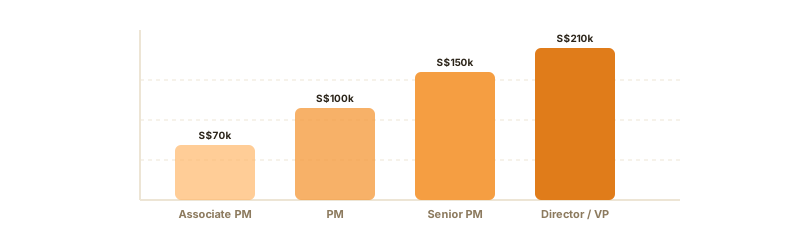
Product management pays well in Singapore, reflecting the role's cross-functional scope and direct impact on business outcomes. Here's the breakdown by seniority, based on data from Glassdoor Singapore:
Associate Product Manager (0–2 years): S$70,000/year
APM roles are your entry point. Companies like Grab, GovTech, and Sea Group run structured APM programmes that pair you with a senior PM mentor and rotate you across product areas. At this level, you're learning the craft — running user research, writing specs, and supporting a senior PM on a product area.
Product Manager (2–4 years): S$91,000/year
Once you own a product area independently, compensation jumps. You're expected to define the roadmap for your area, make data-informed prioritisation calls, and ship features end-to-end with your engineering team.
Senior Product Manager (4–7 years): S$140,000/year
Senior PMs own larger product areas or multiple product lines. You're setting strategy, influencing company direction, and mentoring other PMs. At top-tier companies, total compensation at this level can exceed S$180,000 when you factor in bonuses and equity.
Group Product Manager (7–10 years): S$175,000/year
Group PMs lead a team of product managers. You're responsible for a product portfolio, managing both people and product outcomes. This is where people management becomes a core part of the role.
Director / VP of Product (10+ years): S$210,000+/year
At the director and VP level, you shape product vision across an entire organisation. These roles are rare and highly compensated. Total packages at companies like Grab, Sea Group, and Bytedance can significantly exceed base salary with equity and performance bonuses.
The full salary range for product managers in Singapore spans S$70,000 to S$210,000 per year, depending on experience, company size, and industry.
Skills You Need to Become a Product Manager
Product management demands a broad skill set that spans data, communication, strategy, and technology. Based on Singapore's job market, here are the 20 core skills you need, grouped by category:
Data and analytics:
- Data Literacy — reading dashboards, interpreting trends, and making data-informed decisions
- Analytics Tools — hands-on proficiency with tools like Amplitude, Mixpanel, or Google Analytics
- SQL & Querying — pulling your own data instead of waiting for analysts
- A/B Testing — designing experiments and interpreting statistical significance
- Advanced Analytics — cohort analysis, funnel analysis, and predictive modelling
- Technical Architecture — understanding how systems are built so you can have credible conversations with engineers
- AI & ML Literacy — knowing when machine learning is the right solution and what's feasible
- AI Product Design — designing user experiences that leverage AI capabilities responsibly
- Communication — writing clearly, presenting confidently, and adapting your message to different audiences
- Empathy & EQ — understanding user pain points and navigating team dynamics
- Stakeholder Management — aligning executives, engineers, designers, and business teams around shared goals
- Storytelling — framing product decisions as compelling narratives that drive buy-in
- Leadership Without Authority — influencing outcomes when you don't have direct reports
- User Research — conducting interviews, surveys, and usability tests to uncover real user needs
- Prioritization — deciding what to build and, just as importantly, what not to build
- Product Strategy — defining where the product is heading and why
- Product Discovery — validating ideas before committing engineering resources
- Roadmapping — translating strategy into a sequenced plan that stakeholders can rally around
- Metrics & OKRs — setting measurable goals and tracking progress against them
- Agile & Delivery — working within Scrum or Kanban frameworks to ship iteratively
How to Become a Product Manager in Singapore (Step-by-Step)
There's no single degree that leads to product management. That's part of what makes the role appealing — and also what makes breaking in confusing. Here are the most common routes into PM roles in Singapore.
Route 1: Engineer to PM
This is the most common transition in Singapore's tech scene. If you're a software engineer, you already understand how products are built, which gives you instant credibility with engineering teams. Focus on developing your product sense — start contributing to roadmap discussions, volunteer to run user research, and build a case for transitioning internally.
Route 2: Analyst or consultant to PM
If you come from data analytics, management consulting, or business analysis, you bring strong problem-structuring and quantitative skills. You'll need to develop deeper user empathy and learn how to work within agile delivery teams. Many former McKinsey, BCG, and Bain consultants have made this transition successfully in Singapore.
Route 3: Business or MBA to PM
An MBA from NUS, INSEAD, or a top global programme can open doors to PM roles, especially at larger companies. Several Singapore-based companies actively recruit from MBA programmes. However, an MBA alone won't get you hired — you still need to demonstrate product thinking and user focus.
Step-by-step, regardless of your background:
- Learn the fundamentals — Read "Inspired" by Marty Cagan and "The Lean Startup" by Eric Ries. Understand product discovery, delivery, and strategy frameworks
- Build product experience — If you're not yet a PM, find product-adjacent work. Run a side project, volunteer for product decisions in your current role, or contribute to an open-source product's roadmap
- Develop your data skills — Learn SQL, get comfortable with analytics tools, and practice making data-informed recommendations
- Apply to APM programmes — Companies like Grab, Sea Group, and GovTech run Associate Product Manager programmes specifically designed for career switchers and fresh graduates. These are competitive but offer structured mentorship and rotation
- Use SkillsFuture credits — Singapore residents can use SkillsFuture credits to offset the cost of product management courses, data analytics training, and UX research programmes
- Network in the Singapore PM community — Attend ProductTank Singapore meetups, join local PM Slack communities, and connect with practising PMs. Many PM roles in Singapore are filled through referrals
- Prepare for PM interviews — Practice product sense questions, estimation questions, and case studies. Be ready to walk through a product you've built or improved with concrete metrics
Top Companies Hiring Product Managers in Singapore
Singapore is a regional product hub, which means you have access to companies building for hundreds of millions of users. Here are the top employers for product managers:
Singapore-headquartered:
- Grab — Southeast Asia's super-app, with one of the largest PM teams in the region and a well-regarded APM programme
- Sea Group — Parent company of Shopee and Garena, operating at massive scale across gaming, e-commerce, and fintech
- Shopee — One of the largest e-commerce platforms in Southeast Asia, with complex product challenges in logistics, payments, and marketplace dynamics
- Lazada — Alibaba-backed e-commerce platform with deep regional reach
- GovTech — Singapore's government technology agency, building citizen-facing digital services under the Smart Nation initiative
- DBS — Asia's leading bank, with a strong digital product team transforming banking experiences
- Carousell — Homegrown marketplace platform with a product-driven culture
- Razer — Global gaming hardware and software company headquartered in Singapore
- Bytedance SG — TikTok's parent company, with a growing product organisation in Singapore focused on regional markets
- Stripe SG — Fintech infrastructure company with an APAC product hub in Singapore
Frequently Asked Questions
Do I need an engineering background to become a Product Manager in Singapore?
No. While an engineering background is helpful — especially for technical products — many successful PMs in Singapore come from business, design, consulting, or operations backgrounds. What matters more is your ability to think systematically about user problems, work effectively with engineers, and make data-informed decisions. You don't need to write code, but you do need to understand how software is built at a conceptual level.
What is the salary for an entry-level Product Manager in Singapore?
Associate Product Managers with 0–2 years of experience typically earn around S$70,000 per year, based on Glassdoor Singapore data. Starting salaries vary by company — structured APM programmes at companies like Grab or GovTech may offer slightly different packages. With 2–4 years of experience, you can expect to reach S$91,000 or more as you move into a full PM role.
How do I get my first PM job in Singapore with no experience?
Start by building product skills in your current role. Volunteer to define requirements, run user research, or own a small internal tool. Apply to Associate Product Manager programmes at Grab, Sea Group, or GovTech — these are designed for people without PM experience. Build a portfolio of product thinking: write product teardowns, create mock product specs, or document how you'd improve an existing product. Side projects that demonstrate user empathy, prioritisation, and data analysis are valuable.
Is an MBA necessary to become a Product Manager in Singapore?
No. An MBA can help you break into PM — especially at larger companies that recruit from business schools — but it's not a requirement. Many of Singapore's best product managers have no MBA. Companies care far more about your product sense, communication skills, and ability to ship. If you're considering an MBA purely for a PM career switch, weigh the cost and opportunity cost carefully. Building real product experience through side projects, APM programmes, or internal transitions is often more effective.
What is the difference between a Product Manager and a Project Manager?
A Product Manager decides what to build and why — they own the product vision, strategy, and roadmap. A Project Manager focuses on how and when — they manage timelines, resources, and delivery execution. In Singapore's tech companies, these are distinct roles with different career paths. Product Managers need deep user empathy, strategic thinking, and data skills. Project Managers need strong organisational, process, and risk management skills. Some smaller companies combine both roles, but at most established tech companies in Singapore, they are separate functions.
Ready to apply for product manager roles?
Run your resume through our free checker to see how it performs for Singapore employers.
Check my resume →Ready to start your journey?
Explore the interactive skill tree with all the skills mapped out — from beginner to expert.
Explore the full skill path →