Best SkillsFuture Courses in Singapore (2026): Ranked by Category
The best SkillsFuture courses in Singapore for 2026, ranked by official popularity data, TRAQOM satisfaction scores, and real learner feedback — from Gen AI to aircon maintenance.
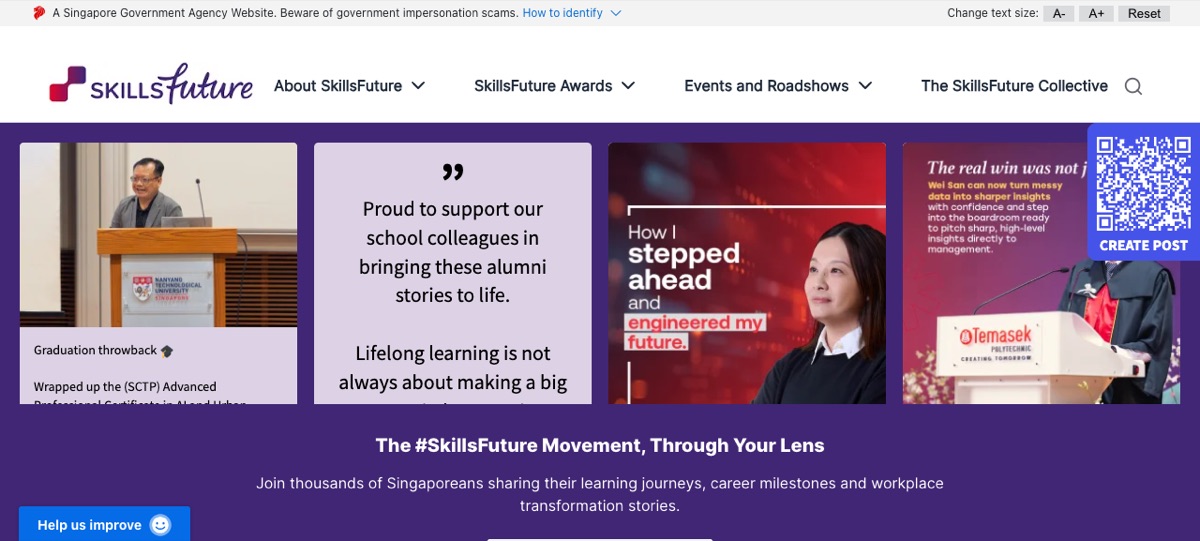
Every Singaporean aged 25 and above has at least S$500 of SkillsFuture Credit sitting in their account — and if you're 40 or older, another S$4,000 under the SkillsFuture Credit (Mid-Career) that never expires. Yet most people either never touch it or burn it on the first course an Instagram ad shows them. This guide ranks the SkillsFuture courses actually worth your credits in 2026, sorted by category and ranked using signals that are harder to game than marketing: SkillsFuture Singapore's own popular-course data, TRAQOM satisfaction scores (the government's official post-course survey), review volume, and what learners actually say on forums after finishing.
One housekeeping note before the list: the one-off S$500 top-up issued in 2020 expired on 31 December 2025 and can no longer be used. Your base S$500 credit has no expiry, and the S$4,000 mid-career credit (age 40+) has no expiry either. SkillsFuture Singapore has also merged with Workforce Singapore to form the Skills and Workforce Development Agency (SWDA), so don't be confused when official emails start arriving from a new name. All claimable courses live on the official MySkillsFuture portal.
How We Ranked These Courses
Course marketing in this space is aggressive, so we weighted signals that providers can't easily buy:
- Official popularity — SkillsFuture Singapore publishes its own list of the most-taken courses on MySkillsFuture, which tells you where Singaporeans actually put their credits
- TRAQOM scores — the Training Quality and Outcomes Measurement survey that SSG sends every funded learner; providers with consistently high TRAQOM scores publish them
- Review volume and consistency — a 4.8 rating across thousands of Google reviews beats a 5.0 across forty
- Forum sentiment — what people say on Reddit and HardwareZone six months after the course, when the certificate glow has worn off
- Job-market relevance — cross-referenced against the salary and demand data from our own career guides
Category 1: Generative AI & Data — The 2026 Demand Leaders
1. WSQ Generative AI for Content and Productivity courses. The single hottest category on MySkillsFuture right now — SSG's own popular-courses list is headlined by "Boosting Efficiency and Content Strategy with Generative AI". Short (1–3 days), immediately applicable to almost any desk job, and available from multiple providers. Forum consensus: the fundamentals courses are genuinely useful for professionals who haven't touched AI tools; skip the advanced-sounding ones until you've used the basics at work for a month.
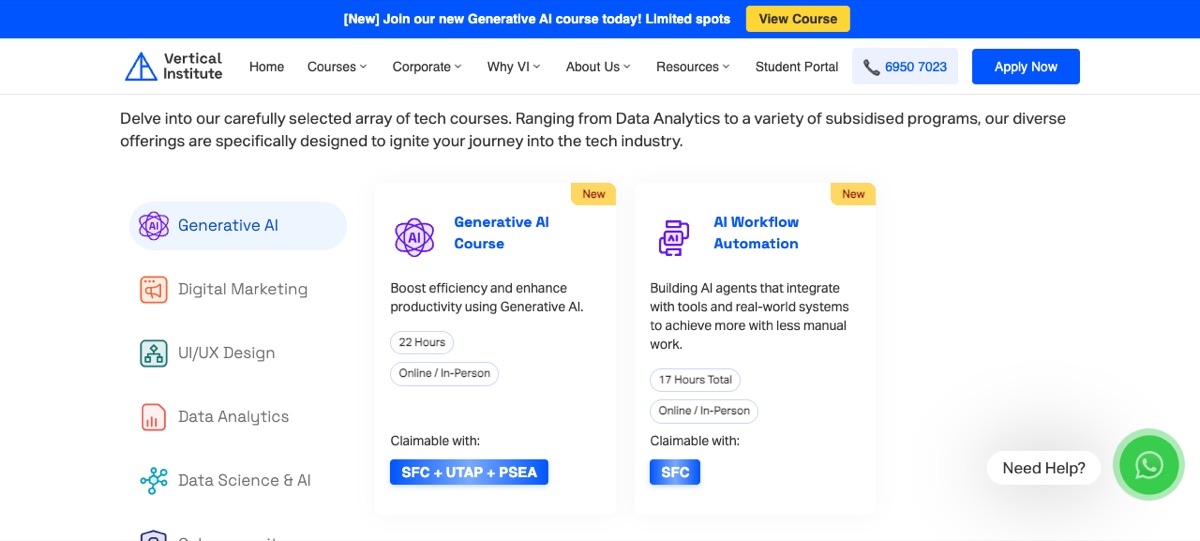
2. Data Analytics (multi-week certificate courses). The most established credit-worthy category, with SSG's Jobs-Skills reporting consistently listing data skills among Singapore's fastest-growing. Vertical Institute, General Assembly, NTUC LearningHub, and Heicoders Academy are the big names. The honest forum take: these courses teach real Excel/SQL/Tableau foundations and are excellent for adding data literacy to a non-tech role — but a 21-hour certificate alone won't make you a data analyst. Pair it with our data analyst career path to see the full skill set employers expect.
3. Fundamentals of Python Programming. On SSG's official popular list, and the best value-per-credit-dollar path into tech skills. Python fundamentals transfer to data work, automation, and further programming study. Realistic expectation: this is a foundation, not a bootcamp — see what a full software engineer roadmap looks like before assuming one course changes careers.
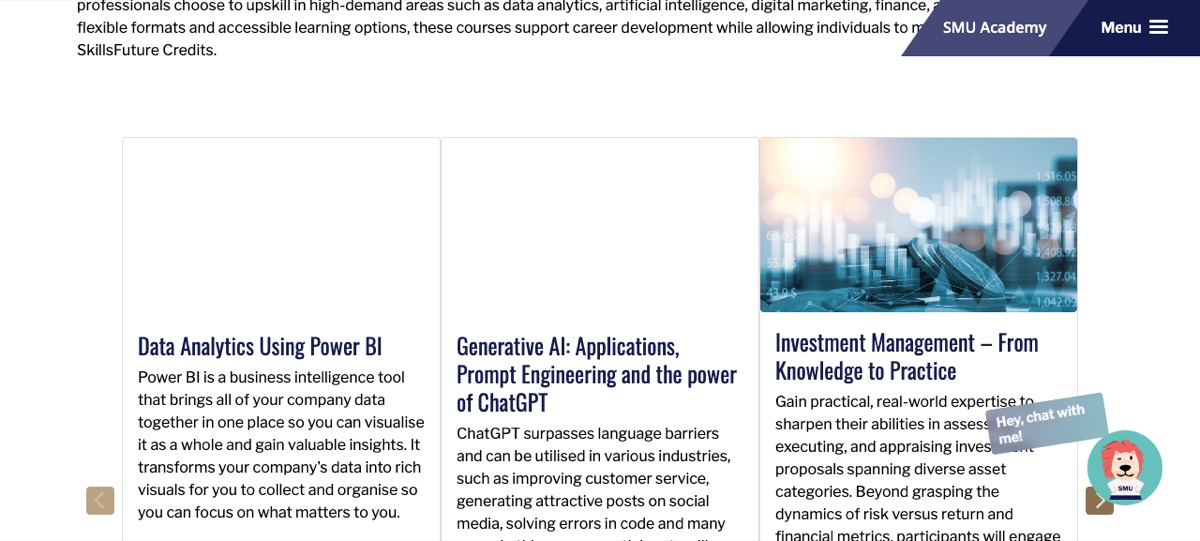
4. Data Analytics with Power BI (SMU Academy). University academies charge more but carry institutional weight on a resume, and their short courses are SkillsFuture-eligible — see SMU Academy's SkillsFuture course catalogue and NUS SCALE for the flagship offerings. SMU Academy's data and Gen AI short courses are the most popular of the university programmes.
Category 2: Digital Marketing & Design
5. WSQ Digital Marketing Essentials. On SSG's official popular-courses list, and one of the few on it that also qualifies for the S$4,000 mid-career credit. The skills (campaign planning, SEO, paid social, analytics) map directly to real job requirements — compare the digital marketer career path.
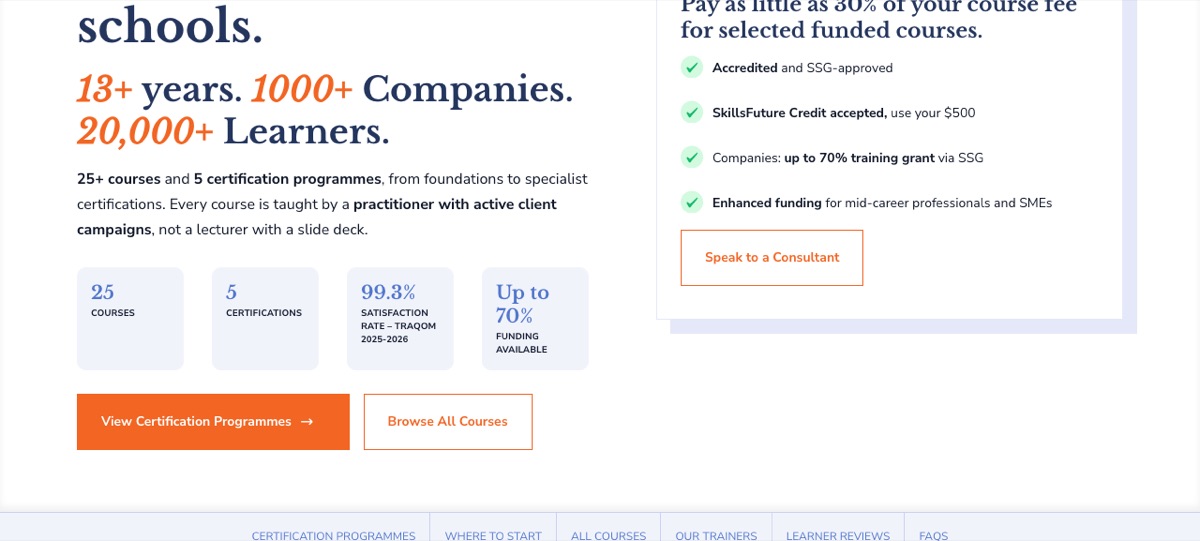
6. Equinet Academy's WSQ digital marketing certifications. The provider forums consistently recommend for marketing: practitioner-trainers, a 99.3% satisfaction rate on TRAQOM (2025–2026), and 20,000+ learners over 13 years. Their certification programmes stack multiple WSQ modules toward a Certified Digital Marketing Strategist pathway.
7. UI/UX Design fundamentals. Consistently popular with career switchers and product-adjacent professionals. Good courses teach Figma plus research basics; check our UX designer guide for the salary reality (S$50k–S$90k+) before committing to the longer diplomas.
Category 3: Business & Communication Skills
8. Public speaking and presentation courses. Two entries on SSG's official popular list ("Speak Sell Succeed" and "Voice Confidence Course") are communication courses — Singaporeans know exactly what's holding them back. Low cost, one to two days, and the skill compounds across every job. Forum verdict: unglamorous but among the least-regretted uses of credit.
9. Behavioural Conflict Management. Also on the official popular list. Especially valued by team leads and anyone in customer-facing roles; several reviewers describe it as the course they wish they'd taken years earlier.
10. Project management certifications (WSQ / preparatory). Not on the official popular list but perennially high-volume: structured project management short courses are a proven salary lever — project coordinators earn S$40k–S$60k and the path up runs through exactly these frameworks.
Category 4: Care & Community
11. Caregiver Training Certification (Basic). On SSG's official popular list, and arguably the most practically valuable course here for the sandwich generation: it teaches you to care for an elderly or recovering family member safely. Also the entry point for paid caregiving work.
12. Counselling Skills Training. Official popular list again — para-counselling skills for supporting colleagues, students, or community members. A common first step for people exploring the psychologist or social worker direction without committing to a Master's.
13. (SCTP) Certificate in Healthcare Administration. A full SkillsFuture Career Transition Programme — longer, heavily subsidised, qualifies for the mid-career credit, and designed to actually move you into healthcare administration jobs. If you're 40+ and doing a full-time SCTP, the Mid-Career Training Allowance pays 50% of your average income (S$300–S$3,000/month, up to 24 months lifetime); from 1 March 2026 selected part-time programmes pay a flat S$300/month.
Category 5: Practical Life Skills (Don't Laugh — They're Top Sellers)
14. Basic Aircon Maintenance with Hands-On. Genuinely on SSG's official popular-courses list, and forum favourite of the "credits well spent" threads. In a country where every home runs aircon, learning to service your own units pays for itself within a year — and it's the gateway to the HVAC technician trade, where demand permanently exceeds supply.
15. First Aid + CPR/AED certification. Cheap, one day, occasionally life-saving, and a requirement or advantage for coaching, childcare, security, and pet-care side gigs. One of the most utilitarian swaps for leftover credit.
16. Urban Farming. On the official popular list — Singapore's 30-by-30 food security push made this more than a hobby course, and it pairs with a genuine urban farming side hustle.
How to Choose (and the Red Flags)
- Check the course exists on MySkillsFuture first. If a provider's "SkillsFuture-claimable" course doesn't appear in the official portal search, walk away.
- TRAQOM over testimonials. Any provider can cherry-pick quotes; ask for their TRAQOM scores or find providers who publish them.
- Beware "free after subsidy" ads. Subsidies are real (up to 70% for SG citizens, more for 40+), but aggressive "essentially free" marketing usually signals a provider optimising for credit capture, not teaching quality.
- A certificate is a start, not a career switch. Forum threads are full of people disappointed that a 3-day course didn't change their job. It won't — but it reliably starts the compounding. Map any course against the full skill tree for your target role on our career pages so you know what the course covers and what it doesn't.
Scams and Pressure Tactics to Watch Out For
Anywhere the government puts money, opportunists follow — and the SkillsFuture space has attracted its share. A few patterns to guard against:
- Roadshow and mall-booth sign-ups. Physical promoters at MRT stations and shopping malls are paid to close you on the spot, and the classic tools are "today-only discounts" and forms that commit you before you've compared anything. A legitimate course will still exist next week at a similar price. Take the brochure, walk away, verify the course on MySkillsFuture, read independent reviews, and decide at home. Never make any payment or sign anything at a booth — and never, under any circumstances, log in to Singpass on a promoter's tablet or share your Singpass details so someone can "process the claim for you". Credit claims are made by you, through the official portal, only.
- Fake and incentivised reviews. Review-for-discount schemes are common in this industry — learners are offered a rebate, freebie, or lucky draw entry for a 5-star Google review, often submitted in class before the course has even ended. Read the nuance: clusters of 5-star reviews posted the same week with similar phrasing are a tell, as are reviews that praise the "fun trainer" but say nothing about what was learned or what happened after. The 3-star reviews are usually the most honest ones on the page, and forum sentiment written months after completion beats any on-page testimonial.
- Phishing and "expiring credit" messages. Scammers periodically run SMS and call campaigns claiming your SkillsFuture credits are expiring and offering to "help you claim" them. Government agencies will never ask for your Singpass password, OTP, or a money transfer over the phone. When in doubt, ignore the message and check your balance yourself at the official portal.
- When in doubt, default to institutions. Public institutions — university academies like SMU Academy and NUS SCALE, polytechnics, and long-established national providers — carry accountability that a two-year-old private academy with aggressive ads simply doesn't. You may pay a little more or get a less flashy website, but the accreditation, trainer vetting, and complaint channels are real. For private providers, check how long they've operated, whether they publish TRAQOM scores, and whether their trainers are named, credentialed people you can look up.
FAQ
How do I check my SkillsFuture Credit balance?
Log in to the MySkillsFuture portal with Singpass and your balance is shown on your dashboard, split by credit type — base credit (no expiry) and, for those 40 and above, the SkillsFuture Credit (Mid-Career) of S$4,000 (also no expiry). The one-off S$500 top-up from 2020 expired on 31 December 2025 and no longer appears as usable balance.
Did the S$500 SkillsFuture top-up really expire?
Yes. The one-off S$500 top-up credited to all eligible Singaporeans in 2020 expired on 31 December 2025 and cannot be used for courses starting from 1 January 2026. Your original S$500 opening credit is unaffected and never expires, and the S$4,000 mid-career credit for those aged 40+ also has no expiry date.
What courses can I use SkillsFuture Credit on?
Only courses listed on the MySkillsFuture course directory are claimable — this includes WSQ courses, SkillsFuture Career Transition Programmes (SCTP), university academy short courses, and thousands of provider courses from Gen AI to aircon maintenance. Search the official portal before paying any deposit, and note that some courses accept the base S$500 credit but not the mid-career S$4,000, which is restricted to selected career-focused programmes.
Are SkillsFuture courses free?
Rarely fully free, but heavily subsidised. Singapore citizens typically get up to 70% course fee subsidies (higher for those 40 and above under the Mid-Career Enhanced Subsidy), and SkillsFuture Credit can offset most or all of the remaining out-of-pocket fee for shorter courses. Longer certificate programmes usually still involve some cash top-up — treat "free after subsidy" marketing claims with scepticism.
What is the best SkillsFuture course for career switching?
A full SkillsFuture Career Transition Programme (SCTP) rather than a short course — SCTPs are multi-month, job-focused, heavily subsidised, and eligible for the S$4,000 mid-career credit. If you're 40 or older and study full-time, the Mid-Career Training Allowance also pays 50% of your average income (capped at S$3,000/month, 24 months lifetime), which is the single most underused scheme in the entire SkillsFuture system.
How do I avoid SkillsFuture course scams?
Three rules cover most of it. First, never commit at a roadshow booth — verify the course exists on the official MySkillsFuture portal and decide at home, away from time-limited discount pressure. Second, never share your Singpass login or OTP with a promoter or provider; credit claims are made by you through the official portal only, and government agencies never ask for passwords or money transfers by phone or SMS. Third, discount review incentives are common in this industry, so weight independent forum feedback and 3-star reviews over on-page testimonials, and lean towards public institutions and long-established providers when unsure.
Can I use SkillsFuture Credit for hobby courses like baking or languages?
Yes, if the specific course is listed on MySkillsFuture — many language, culinary, and craft courses are claimable, and lifestyle learning is a legitimate use of the base S$500 credit. The S$4,000 mid-career credit is deliberately restricted to career-oriented programmes, so hobby courses generally can't draw on it.